BIM Services
 Architectural
 Structural
 MEP
MEP Facade
 Industrial

Looking at the Shanghai Tower in China and Spain’s La Sagrada Familia, one might think they’re vastly different. But they have one thing in common: Building Information Modelling, or BIM, has been the key to their transformations.
One of the biggest game changers in the Architecture, Engineering and Construction (AEC) sector, BIM has turned the way construction projects are brought to life.
Prior to the advent of BIM, architects and engineers only used 2D drawings to visualize the design and dimensions of buildings. However, factors like materials, costs, workforce and deadlines often caused a huge gap between the idea and the end result.
The people behind BIM wanted a system that could close that gap, and merge creative vision with the realities of the real world. What started as fairly basic 2D digital drawings has now grown into mind-boggling, three-dimensional models that merge geometry, time, price, and sustainability.
The Journey from 2D to Multi-Dimensional BIM
The 2D Era: Foundation of Digital Design (1960s-1980s)
The construction industry mainly used hand-drawn blueprints. During the 1960s and 1970s the industry adopted digital 2D Computer-Aided Design (CAD) systems that allowed the industry to move away from the clunky pen, pencil, and paper drafts to a more organized system. In 1982 Autodesk broke ground by releasing AutoCAD, a CAD software and the .dwg format. These new computer-aided designs were more precise than traditional blueprints and reduced the chances of human error.
Despite the technological improvements, 2D drafting faced several limitations. The designs could still only provide basic representations that did not capture the full complexity of modern buildings. The data about materials and components had to be recorded separately. For revisions, engineers had to scan through multiple files, which also caused troubled workflows that were filled with errors and miscommunications.
3D Modeling: Introduction of Realistic Visual Representations (1980s-1990s)
The 1980s saw a transition from 2D CAD to 3D modeling. Designers were able to design more realistic representation as opposed to the basic dimensions and drawings possible earlier. These geometric visualizations provided the means to identify design issues more accurately. Nonetheless, these systems still did not have the means to represent detailed information needed for construction and maintenance.
A major breakthrough for the industry occurred in 1987. Graphisoft released ArchiCAD, recognized as the first BIM software available on personal computers. ArchiCAD changed the game as it allowed architects to create a “Virtual Building” model that included geometric and functional data. Its introduction marked the beginning of true BIM as we know it today. The product is now a prominent and widely used BIM software platform globally.
Modern BIM: Beyond Simple Geometric Models Through Parametric Modeling (1990s)
The term “Building Information Model” first appeared in a 1992 paper by G.A. van Nederveen and F.P. Tolman.
Parametric modeling, a fundamental part of BIM development, was introduced in the 1990s. It is the creation of a digital model in which the dimensions and relationships between elements are defined by parameters. It is what allows BIM to move beyond simple 3D models and handle information and change management efficiently.
BIM: Mainstream Use and Growth (2000s)
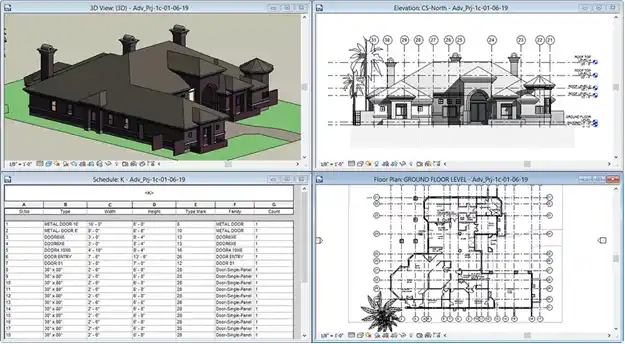
In the early 2000s, BIM started becoming much more popular in the AEC industry. In 2000, Revit was launched. It introduced a parametric change engine that allowed architects and engineers to work in a combined 3D and 2D modeling environment, a huge step forward from previous software. (the company behind Revit would later change its name to Revit Technology Corporation.)
Autodesk, an industry giant, acquired Revit Technology Corporation in 2002. This move was seen as the industry’s recognition of BIM’s potential and provided the necessary fuel for further development.
The BIM Toolkit Evolution
Early Toolkit (1980s–1990s)
- AutoCAD (1982): Introduced 2D drafting, solid modeling, and the now-standard .dwg format.
- ArchiCAD (1987): First BIM software for PCs, offering integrated 2D and 3D design.
- RUCAPS, Sonata, Reflex: Early workstation tools that shaped building modeling concepts.
Modern Toolkit (2000s–2010s)
- Revit: Parametric modeling with integrated design and documentation.
- NavisWorks: 3D coordination and clash detection.
- MicroStation: Comprehensive design and modeling.
- Tekla Structures: Structural modeling and detailing.
- IFC (1997): Standardized data exchange format.
Contemporary Ecosystem (2010s–Present)
- Cloud platforms: Tools like BIM 360, Trimble Connect, and ProjectWise enable multi-stakeholder collaboration.
- Specialized tools: Discipline-specific apps for MEP, structural analysis, and energy simulation, expanding BIM from design to performance.
- Integration platforms: APIs allow different software to “communicate” with each other, allowing cross-platform collaboration and data management.
The Dimensions of BIM: 3D to 5D and Beyond
3D BIM: Spatial Intelligence
3D BIM provides the geometric foundation. In consists of intelligent objects containing material properties, specifications, and relationships. This dimension enables better visualization, clash detection, and design coordination. Capable of collaborative work.
4D BIM: Time Integration
4D BIM adds the time dimension. This is done by linking the 3D model with construction schedules. Project managers can visualize how the building construction will unfold over time. This allows identification of potential delays, efficient workarounds. Construction teams can simulate the entire construction process before beginning the project which enables better resource planning and risk management.
5D BIM: Cost Intelligence
5D BIM adds cost data to 3D model and construction schedule. This dimension allows teams to manage costs more effectively by getting real-time visibility into the cost of design choices. Quantity take-offs become automated, and cost estimates are dynamically updated as the design evolves.
6D BIM: Sustainability Focus
6D BIM incorporates sustainability and energy efficiency data into the building model. This dimension provides information about energy consumption, carbon footprint, and lifecycle performance from the early design stage. It helps to create environment-friendly buildings and efficient management after handover.
7D BIM: Facility Management
7D BIM focuses on operations and facility management throughout the entire building lifecycle. This dimension collates all facility-related information in a single model, including asset data, warranty information, operation manuals, and technical specifications. It allows efficient facility management throughout the lifecycle from design stage to demolition.
Latest Advancements (2024-2025)
Artificial Intelligence in BIM
The integration of Artificial Intelligence with BIM is bringing unprecedented changes in the industry. AI-driven capabilities include Generative Design, Predictive Analytics, Automated Clash Detection, and Natural Language Processing.

Digital Twins Integration
Digital Twins are the future of BIM. A digital twin is a virtual replica of a structure that updates in real-time.
Collaboration via Cloud-based Platforms
Cloud platforms enable real-time data sharing and reduce errors. These platforms allow coordination among global teams.
Advanced Reality Capture (Scan to BIM)
Hyper-accurate site models and updates are created through technologies like Technologies like drones and LiDAR. This “Scan to BIM” technology reduces reliance on manual work while improving accuracy and project monitoring capabilities.
Conclusion
It started as simple digital replacements for hand-drawn blueprints. The evolution from 2D drafting to 5D BIM and beyond has transformed how the AEC industry approaches building design and management. Today, BIM is an advanced digital ecosystem that brings together all aspects of a construction project. From 2D drawings to material data to construction timelines to even predictive models, BIM is becoming the industry standard for smart construction. BIM will keep evolving and become an essential digital infrastructure that enables smart, sustainable, and efficient construction practices.