BIM Services
 Architectural
 Structural
 MEP
MEP Facade
 Industrial

Understanding BIM LOD, Levels, and LOI: Navigating the Depths of Building Information Modeling
The AEC (Architecture, Engineering, and Construction) industry has undergone a significant transition with the adoption of Building Information Modeling (BIM). Going beyond standard design modes, BIM offers a multidimensional approach that combines visual representation, data integration, and collaboration. Within this framework, three key concepts play a pivotal role: BIM LOD (Level of Development), BIM Levels, and BIM LOI (Level of Information).
As the construction and design sectors continue to evolve through digital advancements and interconnected processes, understanding these concepts becomes increasingly vital for professionals, stakeholders, and those eager to learn. By grasping the concept of BIM LOD, professionals can accurately assess the level of detail and reliability of the information within a BIM model at different stages of a project. Similarly, comprehending BIM Levels allows stakeholders to understand the extent to which BIM is being implemented in a project, ranging from basic 2D drafting to fully integrated 3D models. Join us on this journey as we navigate the intricacies of BIM, breaking down each layer of knowledge and shedding light on practical applications that turn concepts into reality.
Exploring BIM LOD, Levels, and LOI
1. BIM LOD (Level of Development)
BIM LOD pertains to the level of detail present in a model, which encompasses factors like the number of primitives within it. It essentially offers an insight into how intricate the model is in terms of its visual representation.
Level of Development (LOD) refers to the degree of completeness and detail to which a Building Information Model (BIM) element has been developed during different phases of a construction project. It is a widely recognized standard for defining the level of detail and accuracy that a BIM object or element should have at various stages of the project lifecycle. The concept of LOD is used to ensure clear communication among project stakeholders and to manage expectations regarding the quality and maturity of the BIM data. It helps prevent misunderstandings and discrepancies by specifying the exact level of information that should be included in the BIM model at each stage of the project.
The American Institute of Architects (AIA) and the Associated General Contractors of America (AGC) have developed a standardized LOD framework that consists of different levels, commonly referred to as LOD 100, LOD 200, LOD 300, LOD 350, LOD 400, and LOD 500. This LOD definition defined by AIA is widely adopted by the AECO industry. Each level represents a specific level of detail and information:
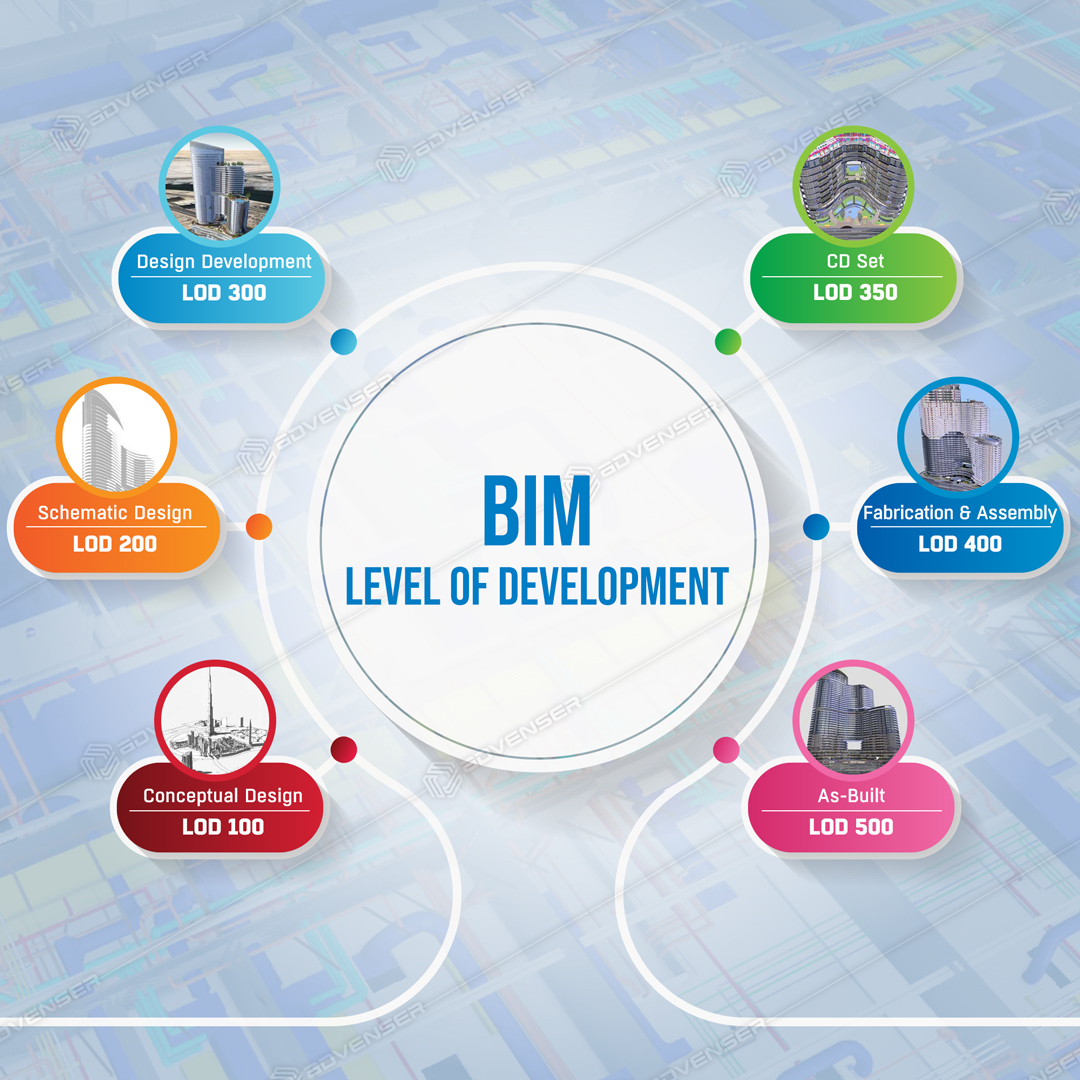
- LOD 100 – Conceptual Design: Basic representations used to convey the overall shape, size, and location of elements. It provides a rough idea without specific dimensions or details.
- LOD 200 – Schematic Design: More detailed representations that include approximate dimensions, shapes, and locations of elements. This level is used to support design decisions.
- LOD 300 – Design Development: Accurate models that represent elements with specific/precise dimensions, shapes, quantities, and locations.
- LOD 350 – Construction Documentation / Coordination: A coordination-ready model that clarifies interfaces and connections to run clash detection and resolve issues. It bridges design and construction, articulating element interactions via graphics and written definitions (not necessarily fabrication-level).
- LOD 400 – Fabrication & Assembly: Highly detailed models with specific assemblies, precise connections, and relevant metadata used for fabrication and construction.
- LOD 500 – As-Built / Facilities Management: Models that include actual data about the installed elements, suitable for facility management and maintenance.
BIM LOD (UK)
- LOD 1 (Brief): A block model that meets performance requirements and site constraints.
- LOD 2 (Concept): A conceptual/volumetric model including basic areas/volumes, orientation, and cost.
- LOD 3 (Developed Design): Generalized systems with approximate quantity, size, shape, location, and orientation.
- LOD 4 (Production): Coordinated technical design suitable for estimating and regulatory checks.
- LOD 5 (Installation): Construction and assembly model meeting precise component requirements.
- LOD 6 (As Constructed): Construction details captured for asset use and maintenance.
- LOD 7 (In Use): Asset data model for ongoing maintenance and monitoring procedures.
LOD Comparison: RIBA vs. BIMForum vs. ISO 19650
Let’s compare the LOD (Level of Development) specifications provided by RIBA, BIMForum, and ISO 19650. Although all three share the same goal, there are differences:
- RIBA (Royal Institute of British Architects): The RIBA Plan of Work (stages 0–7) is widely used in the UK and structures design/construction processes. While it does not prescribe numeric LODs, it aligns BIM information needs and collaboration by stage and emphasizes information exchange.
- BIMForum LOD Specifications (AIA/AGC): Provides explicit LOD 100–500 definitions covering graphical and non-graphical expectations. Common in the U.S. to set clear stakeholder expectations and improve communication.
- ISO 19650: International standard focusing on organization and digitization of information (including BIM). Emphasizes information management, collaboration, and exchange across the lifecycle rather than prescribing numeric LODs.
In summary:
- RIBA: Stage-based framework aligned with BIM deliverables.
- BIMForum: Detailed, numeric LOD definitions (100–500).
- ISO 19650: Information management and collaborative processes across the lifecycle.
The choice of specification depends on regional practice, contract conditions, and project requirements. Always refer to the current versions.
Level of Development vs. Level of Detail
While a BIM element’s Level of Development assesses how much information it can convey, the Level of Detail deals with the graphical fidelity added to a model.
- Level of Development (LOD): Completeness and accuracy of a BIM element’s information—both geometry and metadata—at defined milestones (e.g., LOD 100/200/300…). It is typically governed by standards/guides and sets what must be known at each stage.
- Level of Detail: The graphical refinement of geometry (vertices, edges, surfaces, curves). It answers, “How detailed and refined is the visual representation?” Different levels of detail serve visualization, design, coordination, or fabrication needs.
2. BIM Levels (Maturity)
One of the crucial aspects of BIM is its classification into maturity levels. BIM maturity ranges from 0 to 3 (and beyond). The aim is to integrate precise and pertinent data into the BIM model throughout the design-build process.
- Level 0: No BIM; traditional 2D CAD deliverables with minimal collaboration and information sharing.
- Level 1: Introduction of 3D in parts; mixed with 2D CAD; limited/partial collaboration, discipline-separate models.
- Level 2: Federated 3D models shared via common formats/IFC within a CDE; improved coordination and information exchange across stakeholders.
- Level 3: Full collaboration and integration using a shared model, real-time data exchange, and lifecycle information. May incorporate 4D (time), 5D (cost), and 6D (asset/lifecycle) per project needs (often termed Open BIM).
- Level 4: Extends BIM outcomes toward improved social value and well-being.
These levels establish a common understanding of BIM capability and expectations for data exchange, collaboration, and deliverables on a project.
3. BIM LOI (Level of Information)
The BIMForum uses Level of Information (LOI) to specify appropriate detail for non-graphical data—such as performance metrics, materials, and sustainability information—at each stage. LOI is critical because non-graphical data significantly impacts construction efficiency, sustainability, and asset operations. LOI represents the amount and reliability of information added to metadata or asset tags.
LOI complements LOD. While LOD governs geometric/visual development, LOI governs the richness and accuracy of associated data. A useful BIM model is therefore both visually representative and information-complete, supporting design, construction, and facilities management decisions while enabling effective collaboration among stakeholders.